While the world debates how smart GPT-5 or Llama 4 are, the crucial driving force behind the scenes — hardware computing power — has also reached a historic moment. NVIDIA officially announced that the new generation Blackwell architecture B200 inference chip has entered full mass production. This chip, hailed as the “world’s most powerful AI engine,” is not just a accumulation of performance, but a comprehensive innovation in AI operational costs.
5x Energy Efficiency: Lightweight Operation for Large Models
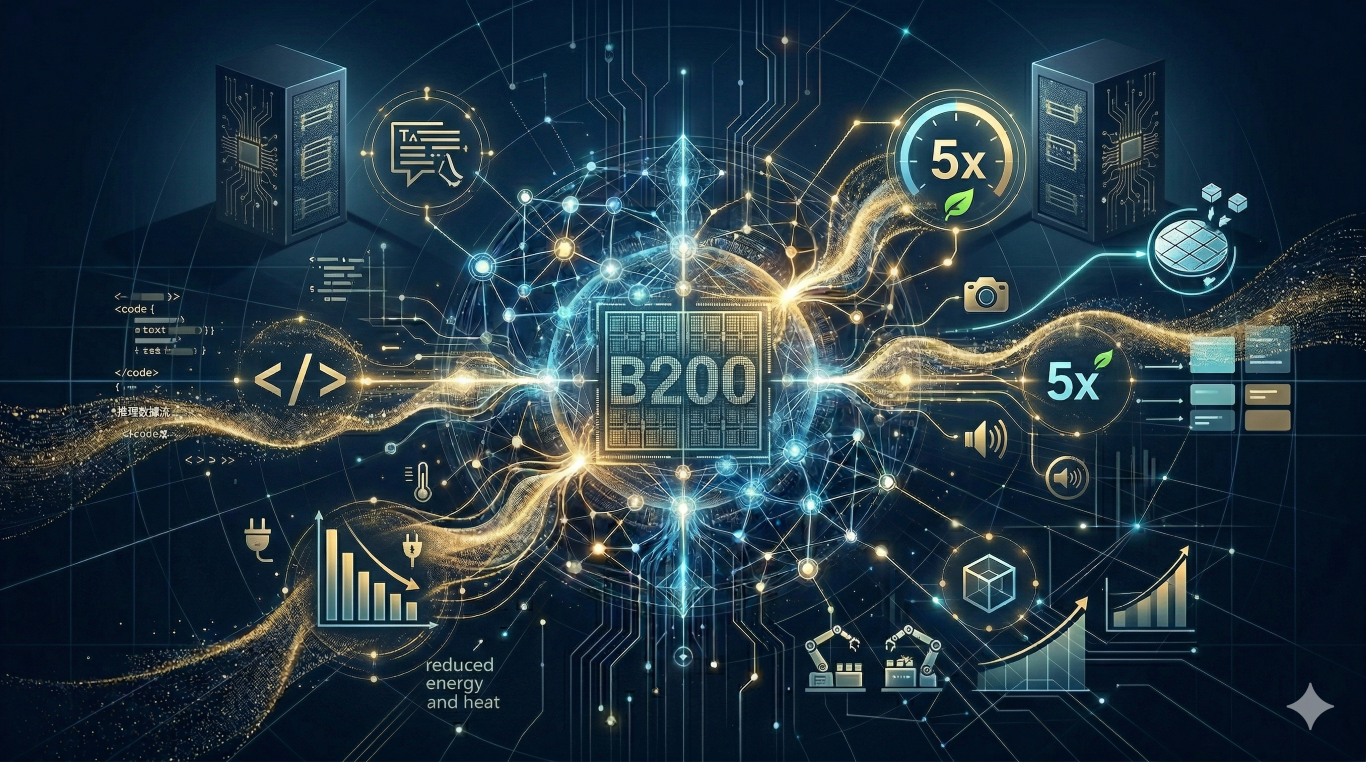
The B200 was created specifically to solve the high energy consumption problem in large language model (LLM) inference. Compared to the previous generation B100, the B200 delivers up to 5x the energy efficiency under the same power baseline.
This breakthrough comes from the brand new “Second-Generation Transformer Engine” in the Blackwell architecture, which dynamically adjusts numerical precision, allowing models to consume fewer computational resources while maintaining accuracy. For tech giants processing billions of requests daily, this means that workloads that previously required five data centers can now be handled by just one, greatly alleviating pressure on global power infrastructure.
70% Cost Reduction: A Turning Point for AI Democratization
Beyond performance, the most shocking number for the market is 70% reduction in operational costs. In the past, the high cost of deploying large-scale AI services put many small and medium-sized enterprises off.
With the mass production of the B200, the cost of generating Tokens (text units) will drop significantly. This not only means faster response times for chatbots, but also that enterprises can integrate AI into automated customer service, real-time translation, and even high-precision image analysis at a lower price. When computing costs are no longer a burden, we will see more innovative AI applications blooming across all industries.
Conclusion: Ushering in a New Era of “Computing Power as Electricity”
The mass production of the NVIDIA B200 symbolizes the AI industry moving from an “arms race” into a new phase of “performance operations.” Jensen Huang has once again proven that through hardware architecture innovation, the growth rate of AI computing power far exceeds what Moore’s Law predicted. As B200 gradually enters data centers worldwide, a future of cheaper computing and smarter services is already within reach.