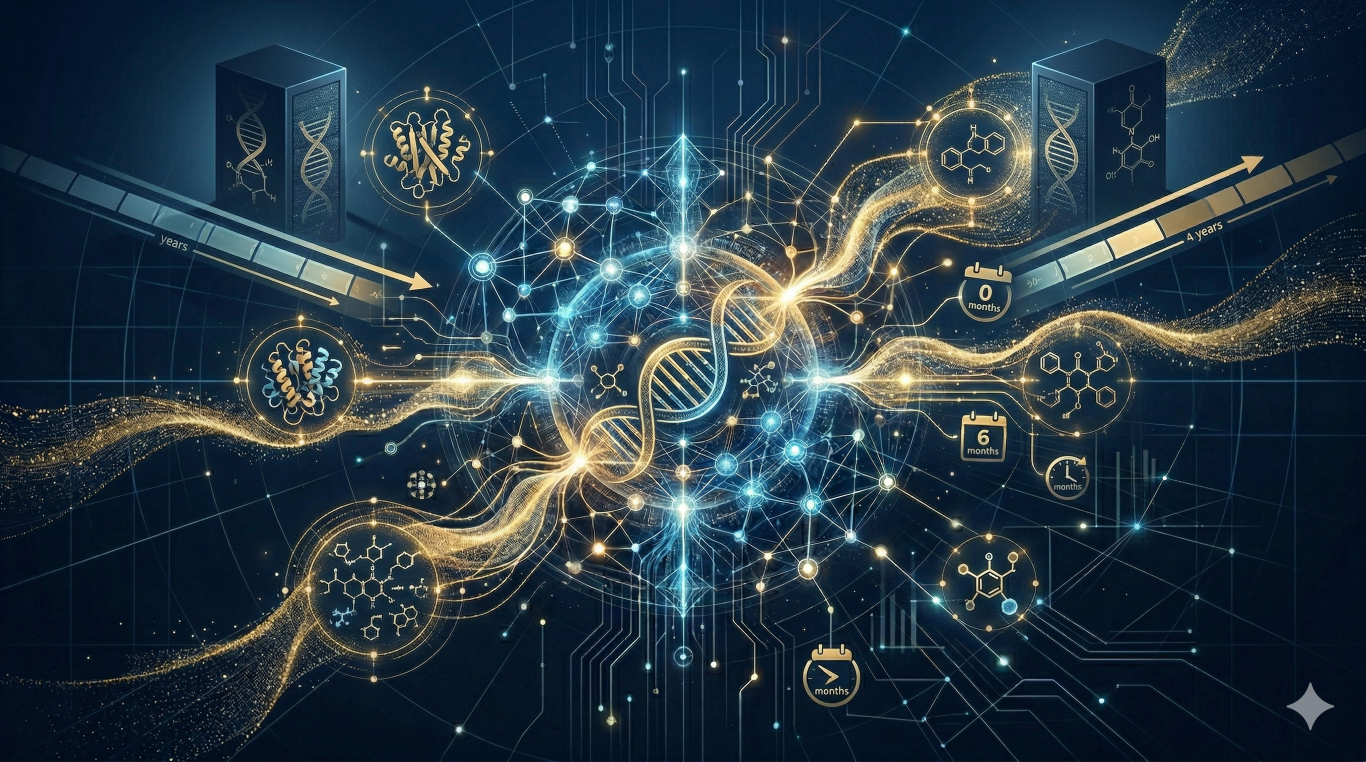
In the biopharmaceutical industry, a cruel “10-10 law” has persisted: developing a new drug takes an average of 10 years and costs $1 billion. However, this pattern is being thoroughly shattered by artificial intelligence (AI). Recently, a biotech company announced that using its AI-driven platform, it completed the entire process from “discovering drug targets” to “identifying clinical candidate drugs” in just 6 months, setting a new industry record.
Digital Simulation Replaces Laboratory Trial and Error
Traditional drug development is like finding a needle in a dark ocean—scientists must manually synthesize and test tens of thousands of compounds to find one promising molecule. The core of this breakthrough lies in the AI platform’s high-dimensional simulation capabilities.
Through generative AI models, the system can screen billions of molecules in digital space. AI can not only accurately predict the binding stability between proteins (targets) and drug molecules, but also simultaneously simulate the drug’s metabolic processes (ADMET) in the human body and potential toxicity. This means that before entering the expensive wet lab, 99% of unqualified candidates have already been eliminated, multiplying R&D efficiency by orders of magnitude.
The Far-Reaching Significance of Shortening Development Timelines
Shrinking from 6 years to 6 months, what is saved is not just money, but patients’ chances of survival. For many rare diseases that currently have no cure, or for sudden infectious diseases like the coronavirus, AI’s acceleration capability will become humanity’s most powerful weapon against global health challenges.
Furthermore, the reduction in R&D costs may in the future be directly reflected in drug prices. When the risk of development failure is precisely controlled by AI, expensive innovative drugs will no longer be the exclusive domain of the few—this is the core vision of “democratizing healthcare through AI.”
Conclusion: The New Normal of AI Drug Research
Although clinical trials (human testing) still require rigorous time observation, the comprehensive digitization of early-stage development is already underway. This 6-month record is just the beginning—as more powerful models like Llama 4 or Gemini join the fray, AI-driven drug research will bring “precision medicine” truly into everyone’s daily life.