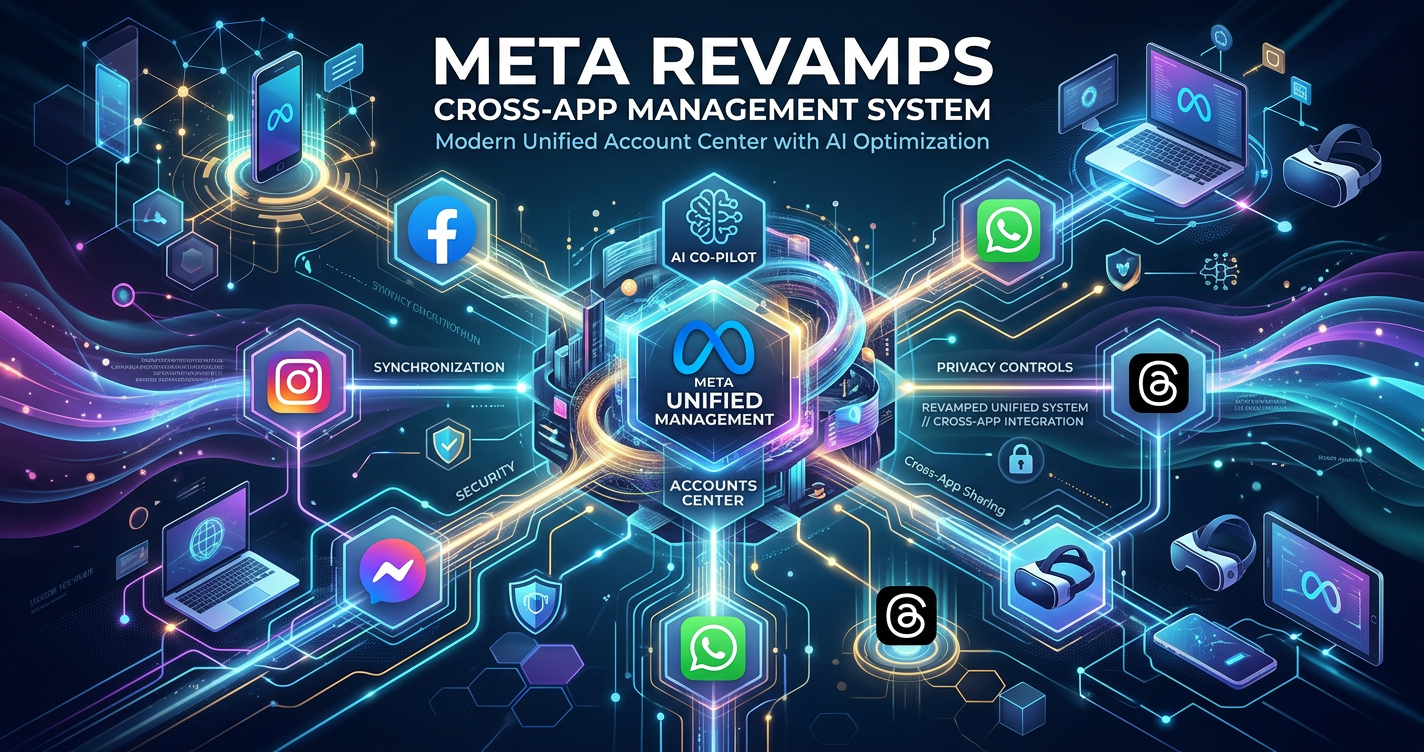
Meta announced on Thursday an improved Meta Account system designed to make it easier for users to sign in and manage their Meta accounts and devices. The company says this new system will roll out over the next year, replacing the current Accounts Center with a more centralized and secure experience across Facebook, WhatsApp, Meta AI glasses, and more.
The Problem: A Fragmented Meta Ecosystem
Let’s be honest — the Meta ecosystem has grown unwieldy. If you use Facebook, WhatsApp, Instagram, and Meta’s hardware like Ray-Ban Meta smart glasses, you’re probably juggling multiple logins and passwords across all of them. The Accounts Center helped somewhat, but it never fully solved the coordination headache of managing settings that don’t change from app to app — your password, two-factor authentication, the email on your account — but still required you to update them in multiple places.
The fragmentation isn’t just an inconvenience. It creates real security gaps. When managing access across six or seven different Meta apps and devices, it’s easy to lose track of which accounts have which protection enabled. That’s exactly the problem the new Meta Account system was built to address.
What the Meta Account Does Differently
The Meta Account shifts cross-app settings into one central dashboard. Passwords, two-factor authentication, and associated email addresses now live in a single place — change them once, and the update propagates across your entire Meta ecosystem. You no longer need to edit the same information inside Facebook, then Instagram, then WhatsApp in separate sessions.
Security is the headline upgrade. The Meta Account supports Passkeys, which let you sign in using biometrics — your fingerprint, face recognition, or your device’s screen lock password. Passkeys are harder to phish than traditional passwords because the credential never leaves your device. On top of that, Meta is rolling out security recommendations that push users toward multi-factor authentication and will send login alerts across all connected devices when a new sign-in occurs.
Here’s a quick breakdown of what’s now centralized versus what stays app-specific:
| Centralized via Meta Account | Stays Inside Each App |
|---|---|
| Password | Who can see your Facebook posts |
| Two-factor authentication | Whether someone can tag you on Instagram |
| Associated email address | Feed preferences |
| Security recommendations | Notification settings |
| Login alerts across devices | App-specific privacy controls |
This split makes sense: settings that don’t change between apps belong in one place, while choices that define how each app feels belong where you’d naturally look for them — inside the app itself.
Parental Supervision Gets a Major Overhaul
For parents supervising teenagers, the old workflow was genuinely painful. Managing a teen’s Instagram settings meant opening Instagram. Managing Facebook Messenger settings meant a separate trip into Facebook. If your kid used Meta Horizon, that was yet another place to navigate.
The Meta Account’s Family Center dashboard changes that equation entirely. Parents can now manage settings for Instagram, Facebook, Messenger, and Meta Horizon from a single view. The days of switching between apps to adjust parental controls are over — at least for the settings that matter across multiple platforms.
Meta was careful to note that app-specific settings remain independent. Whether someone can tag you in an Instagram photo, or who can comment on your Facebook posts, stays inside those individual apps. This isn’t a power grab — it’s a consolidation of the genuinely cross-app stuff.
Flexibility Isn’t Sacrificed
One concern users might have: does this force you to link everything under one Meta Account? The answer is no. If you prefer to keep your Facebook and Instagram logins completely separate, you can. The Meta Account is an option, not a requirement. Users can add or remove accounts from their Meta Account at any time, and non-linked accounts continue to work as they always have.
This is a pragmatic approach. Heavy users of the Meta ecosystem will likely appreciate the consolidation. Power users who want isolation between their personal Facebook and their business Instagram can maintain that separation. Meta isn’t burning bridges — it’s offering a more convenient bridge for those who want to walk across it.
What This Means for Privacy
Beyond convenience, there’s a privacy dimension worth examining. Centralized account management means Meta is building a clearer picture of how users move between its platforms. A single email address associated with multiple Meta apps creates a stronger identity link across the ecosystem than separate logins ever did.
Meta says the cross-app settings don’t change from app to app, which is why consolidating them makes sense. But users should understand that opting into the Meta Account system is also an opt-in to a more unified view of their Meta activity — one that Meta itself controls.
If that trade-off matters to you, the option to keep accounts separate remains. But for the majority of users who already use multiple Meta apps, the convenience probably outweighs the privacy consideration.
The Rollout Timeline
Meta says the Meta Account will roll out over the next year. The company hasn’t specified exact dates for when individual features will become available, but the direction is clear: over the next twelve months, the Accounts Center will gradually transition to the Meta Account as the default way users manage their cross-app identity.
For now, existing Accounts Center users don’t need to take any action. When the migration begins, Meta says it will guide users through the process of setting up their Meta Account. Early adopters who want to get ahead of the curve can likely expect an invitation to opt in before the full rollout begins.
The Bigger Picture
Meta isn’t just solving a UX problem here — it’s building infrastructure. A unified account system makes it easier to expand the Meta ecosystem further, whether that’s new hardware products, new apps, or new features that span multiple platforms. If you can manage everything under one roof, it becomes easier to add new rooms to that house.
That infrastructure play also makes Meta’s platform more competitive with Apple and Google, both of which already offer centralized account management across their respective ecosystems. For Meta to play in that league, it needed to eliminate the account fragmentation that made its ecosystem feel clunky compared to the more unified experiences Apple and Google deliver.
Want to stay updated on the latest developments in AI and tech? Subscribe to our feed at AI-101.tech for daily news and in-depth analysis.