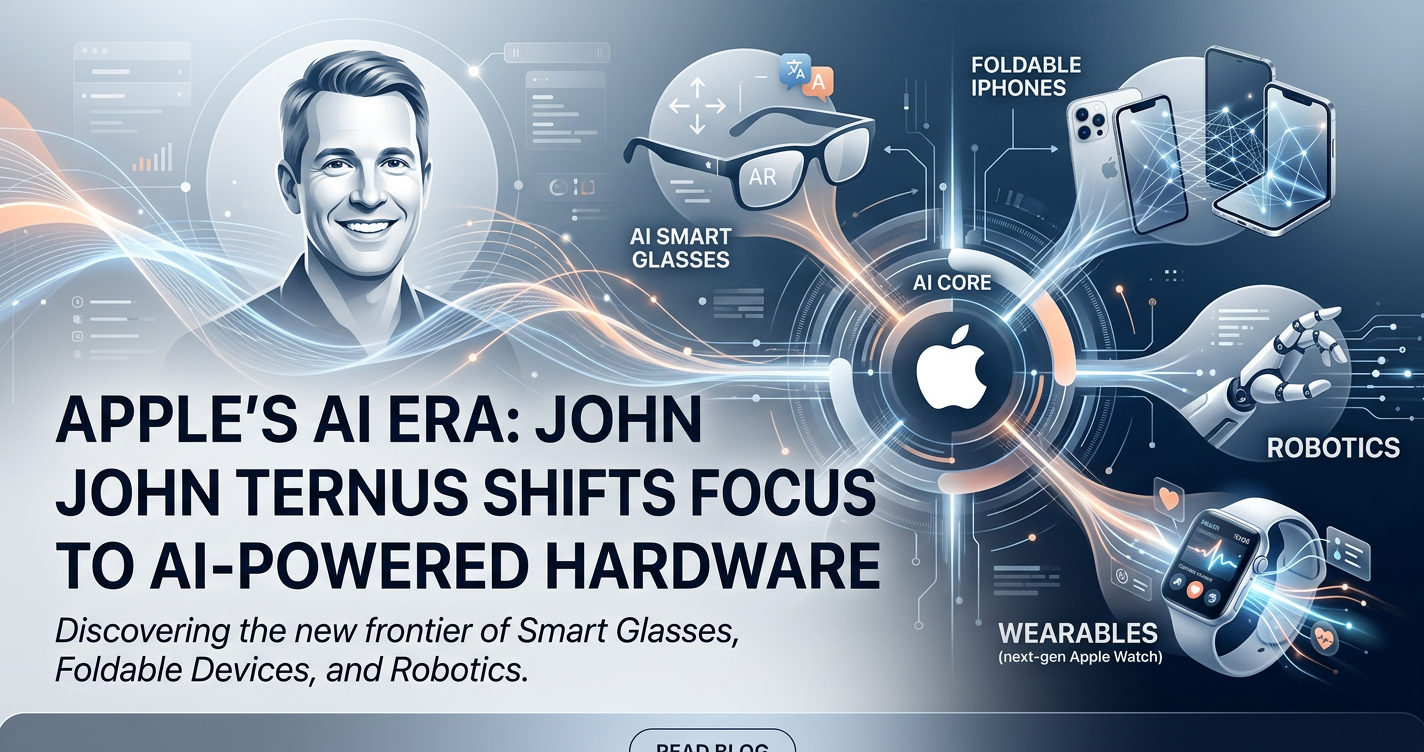
Apple is about to enter a new chapter. On Monday, the company announced that John Ternus will take over as CEO later this year, succeeding Tim Cook — who guided Apple to a $4 trillion market capitalization and built its services business into one of the most profitable wings in tech. Ternus is a hardware man through and through. He joined Apple in 2001 and climbed through the hardware engineering ranks, contributing to AirPods, the Apple Watch, and Vision Pro. His appointment signals something clear: Apple is preparing to put devices — not just software or AI models — back at the center of its strategy.
Who Is John Ternus and Why Does His Appointment Matter?
Cook built Apple into a global powerhouse by mastering supply chains, expanding services, and keeping the ecosystem tightly integrated. Ternus’s resume looks different. He spent two decades building the products that people actually hold, wear, and now strap to their faces. That matters. When a hardware engineer takes the top seat, product direction tends to shift toward — well, hardware.
The timing is notable. Apple is navigating tariffs, memory chip shortages, and mounting pressure to define its role in an AI era where competitors like Google and Microsoft are racing to own the model layer. Ternus’s appointment suggests Apple’s answer might not be another foundation model — it might be another device.
How Does Ternus’s Background Shape Apple’s AI Device Strategy?
Rather than competing head-on with OpenAI, Google DeepMind, or Anthropic to build the most powerful large language model, Ternus is expected to push Apple toward a different angle: AI-powered devices you can hold, wear, and live with. The strategy emerging from reports is to embed AI into the hardware ecosystem already in users’ hands (and on their wrists, ears, and soon faces).
According to Bloomberg, Apple’s roadmap includes several product categories that would all connect back to the iPhone, with Siri acting as the connective tissue. The idea is that AI isn’t just a chatbot — it’s woven into objects that physically exist in your environment. This approach lets Apple leverage its existing installed base of over two billion active devices without trying to out-train OpenAI on model scale.
What New Hardware Categories Is Apple Exploring?
Several product concepts have surfaced in recent reports. None are confirmed, but the patterns are worth examining.
Smart Glasses and Wearables
Apple has been rumored to be developing true smart glasses — not the heavy AR headset category that Vision Pro occupies, but lightweight glasses that look normal and layer information over the real world. A wearable pendant with a built-in camera has also been mentioned in reporting. The goal appears to be ambient computing: devices that are always there without demanding you pull out a phone.
AirPods with AI Features
AirPods are already one of Apple’s fastest-growing product lines. Adding on-device AI — noise cancellation that adapts to context, real-time translation, or Siri interactions that don’t require you to look at a screen — could turn them into something closer to a wearable computer.
Foldable iPhone
After years of speculation, a foldable iPhone may finally arrive in September — right in time for Ternus to oversee the launch personally. Competitors like Samsung have already released multiple generations of foldables, which suggests Apple’s approach has been deliberate: wait until the technology meets Apple’s quality bar, then ship. The September timeline, if accurate, would mark a significant new product category for Apple under new leadership.
Home Robotics
Apple has reportedly been exploring robotics for the home. One concept involves a tabletop device with a robotic arm attached to a display — essentially a smart assistant that can move, orient toward you, and interact physically. Mobile robots that follow users around or function as a moving FaceTime screen have also been part of the discussion.
This aligns with Ternus’s personal history. As reported by the New York Times, he built a device in college that allowed quadriplegics to control a mechanical feeding arm using head movements. Long before robotics became fashionable in Silicon Valley, Ternus was working on machines that extended human capability physically. If Apple does push into home robotics, that background is less coincidence than it might seem.
| Product Category | Status | Reported Timeline | Key Differentiator |
|---|---|---|---|
| Smart Glasses | Rumored, in development | Unknown | Lightweight, iPhone-connected |
| AI AirPods | Rumored | Unknown | On-device AI, contextual sound |
| Foldable iPhone | Highly rumored | September 2026 | Apple’s quality bar for foldables |
| Home Robotics | Exploratory | Years away | Desktop robot with arm and display |
What Challenges Lie Ahead for Apple’s Hardware Future?
Vision is one thing. Execution is another. Three major obstacles stand between Apple’s hardware ambitions and the market.
Memory Chip Shortages
AI-capable devices need sophisticated chips, and the global supply for high-bandwidth memory (HBM) remains constrained. Apple designs its own silicon, but manufacturing still depends on TSMC and others. Any disruption to memory supply cascades directly into product timelines.
Tariff Uncertainty
President Trump’s tariff policies have been volatile, creating unpredictability for companies with complex global supply chains. Apple’s reliance on Chinese manufacturing — roughly 80% of iPhones were produced in China before recent tariff shifts — means any new trade policy can quickly erode margins or delay launches.
India Manufacturing Transition
Apple has been diversifying production to India, where about 25% of iPhones were manufactured last year according to Bloomberg. This transition is underway but incomplete. Until the India operation scales to match China’s efficiency and workforce skill, Apple’s cost structure and supply chain resilience remain works in progress.
These aren’t small headwinds. But they’re not new to Apple either. The company has navigated tariff conflicts, component shortages, and geopolitical pressure before — and come out the other side with major product launches intact.
The Bigger Picture: Why This Transition Matters
John Ternus taking over as CEO isn’t just a leadership change. It’s a signal about where Apple believes the next decade of growth will come from. Cook’s era was defined by ecosystem lock-in, services revenue, and the App Store as a platform. Ternus’s era, if his background is any indication, may be defined by putting physical, AI-capable objects back into the hands — and onto the bodies — of billions of users.
That doesn’t mean Apple’s AI ambitions are small. Siri’s role as the ambient interface across all these devices suggests AI is still foundational to the strategy. But Apple’s angle is different from Microsoft or Google: Apple is betting that the device is the AI, not just a window into it.
Whether that bet pays off depends on whether the products live up to the hype — and whether Ternus can execute on hardware at a scale and quality level that Apple customers have come to expect. The September foldable launch, if it arrives, will be the first real test.
Stay updated on the latest AI developments, tech industry shifts, and product launches — subscribe to AI-101.tech for daily coverage of the technologies shaping our future.