1. GPU Market Status: NVIDIA’s Throne and Moat
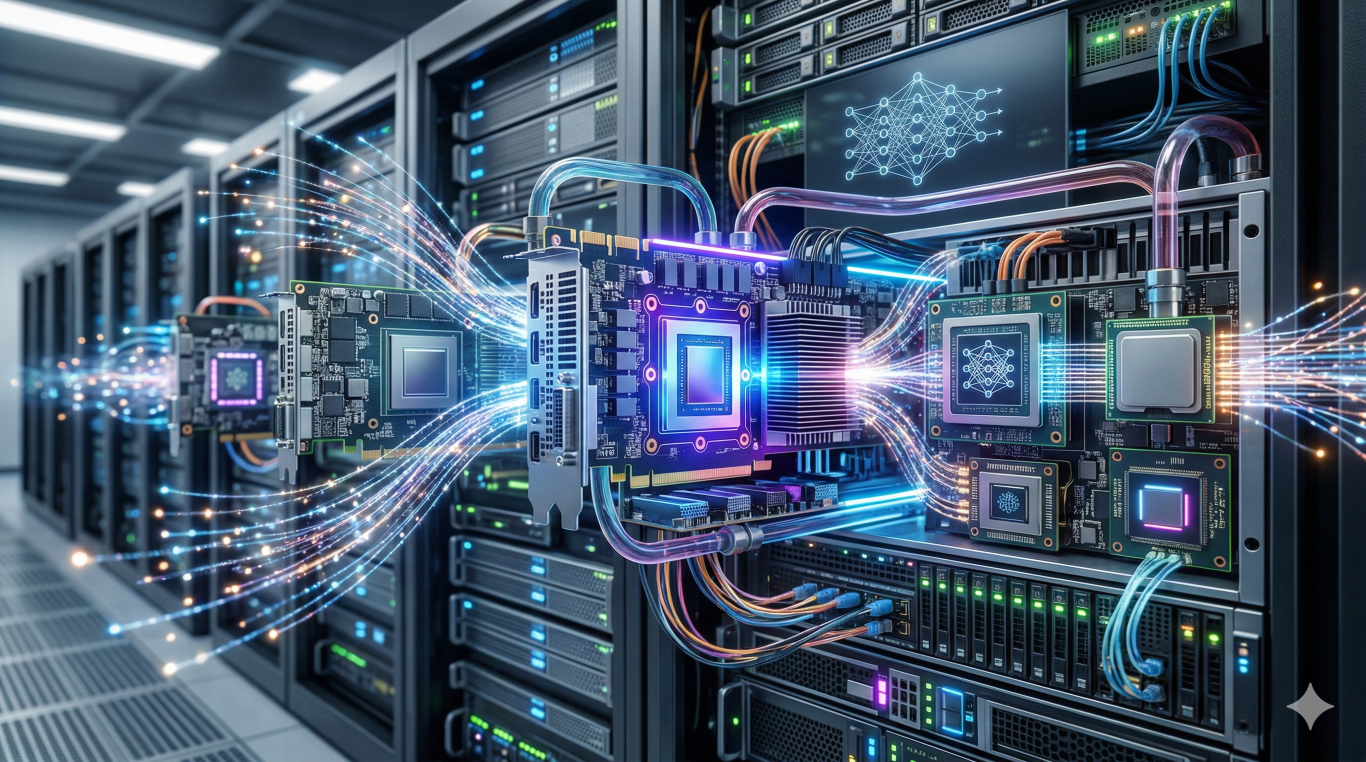
As of 2026, NVIDIA maintains over 80% market share in the data center AI accelerator space. This monopoly is not built on hardware performance alone, but on a deep “software-hardware integrated” ecosystem.
1.1 The CUDA Ecosystem: The Most Powerful Software Moat
NVIDIA’s core asset is not the chip — it’s CUDA (Compute Unified Device Architecture). After nearly 20 years of iteration, CUDA has become the standard language for AI developers.
- Development inertia: Hundreds of millions of developers are accustomed to CUDA libraries (cuDNN, cuBLAS). Migrating code to other platforms carries extremely high costs and risks.
- Open source community support: Almost all top AI frameworks (PyTorch, TensorFlow) prioritize NVIDIA GPU optimization when releasing new features. This creates a positive feedback loop: hardware strong → more software → more developers → stronger hardware.
1.2 Blackwell Architecture and NVLink: System-Level Leadership
The Blackwell architecture launched in 2024, and subsequent iterations, push compute units to physical limits.
- FP4 precision and second-generation Transformer Engine: Chips like the B200 support lower numerical precision (FP4), boosting compute power several-fold without sacrificing model inference capability.
- NVLink networking: NVIDIA recognized that single-chip improvements were hitting a ceiling, so it shifted focus to “system as chip.” Through fifth-generation NVLink, thousands of GPUs can work together as a single massive chip, solving the communication bottleneck in large-scale model training.
2. Rise of Alternatives: Attackers’ Technical Paths
Facing NVIDIA’s dominance, cloud giants and traditional chipmakers are trying to find cracks through “vertical integration” and “open-source alternatives.”
2.1 Google TPU: Extreme Optimization for Tensor Computing
Google’s TPU (Tensor Processing Unit) is currently the only solution that can rival NVIDIA at scale in large-scale training tasks.
- Architectural advantage: Unlike GPUs’ generality, TPUs are designed specifically for matrix operations. Their systolic array architecture achieves extremely high energy efficiency when executing the core operations of Transformers.
- v5p and supercomputer clusters: The latest TPU v5p, through optimized Pod interconnect technology, allows Google to run Gemini and other ultra-large models on its own cloud at lower cost, achieving a closed loop from chip to algorithm.
2.2 AMD ROCm: From Hardware Catch-Up to Software Breakthrough
AMD’s Instinct MI300/MI400 series hardware specs (HBM memory capacity and bandwidth) actually surpass NVIDIA’s comparable products.
- ROCm’s open strategy: AMD knows it cannot win against CUDA in a closed ecosystem, so it推动 ROCm (Radeon Open Compute)’s open-source and standardization. Through the Triton language and deep PyTorch integration, developers can now more easily migrate models from CUDA to AMD platforms — significantly weakening NVIDIA’s software lock-in effect.
3. Novel Architecture Innovation: Disruption at the Physical Layer
As the traditional Von Neumann architecture faces “memory wall” and “power wall” limitations, novel computing technologies are moving from lab to mass production.
3.1 Compute-in-Memory (CIM / Processing-in-Memory): Eliminating Data Movement
In AI computation, approximately 90% of energy is wasted on data movement between memory and processors.
- Technical principle: Compute-in-Memory directly executes multiply-accumulate (MAC) operations within storage cells (RRAM, MRAM). This eliminates the data bus bottleneck.
- Application scenarios: For edge AI (smartphones, wearables), CIM can provide 100x the energy efficiency of traditional architectures, making real-time AI with long battery life possible.
3.2 Photonic Computing: Inference at Light Speed
Silicon photonics technology uses photons instead of electrons for signal transmission and computation.
- Low latency and high bandwidth: Optical signals generate almost no resistive heat, and can transmit data in parallel across different wavelengths (wavelength division multiplexing).
- Photonic matrix computation: Through interferometer arrays, photonic computing can complete large-scale matrix multiplication at nanosecond speeds. While challenges remain on the training side, photonic accelerators show amazing potential for large model inference.
4. Market Outlook and Strategic Competition
4.1 Democratization of Compute and Sovereign AI
Governments worldwide are recognizing the importance of AI compute, driving “sovereign AI” initiatives. This has fueled development of specialized ASICs (Application-Specific Integrated Circuits). By 2030, non-GPU architecture AI accelerators are projected to capture approximately 35% of the market.
4.2 From General Compute to Vertical Optimization
The future compute market will be stratified:
- Top tier (Training): NVIDIA and Google continue competing on trillion-parameter model training grounds, with emphasis on communication bandwidth and ecosystem maturity.
- Middle tier (Enterprise inference): AMD, Intel, and cloud custom silicon (AWS Inferentia) compete for the installed base with high cost-performance ratios.
- Bottom tier (Edge computing): CIM and RISC-V architecture chips dominate the low-power market.
5. Conclusion
AI hardware competition has shifted from pure “transistor racing” to “system-level optimization” and “physical paradigm innovation.” While NVIDIA’s GPUs will remain the hegemon for the foreseeable future, waves of technological innovation are tearing cracks in the facade. Whether it’s Google’s vertical integration, AMD’s open-source counterattack, or the emergence of silicon photonics technology, all are driving down AI compute costs together.
For enterprises, flexible hardware adaptation capability will become a core competency. For the industry, diversified compute development will ensure AI technology is not monopolized by a single vendor — opening an era of greater resilience and innovation.